
Wind-Solar Hybrid Power Model
Wind power generation and solar power generation are combined to make a WIND-SOLAR HYBRID POWER GENERATION SYSTEM. A 6v, 5Ah lead-acid battery is used to store solar power and charging is controlled by a charger circuit.

Design Estimation of 5KWp BIPV Solar Power System
Design Estimation of 5KWp BIPV Solar Power System

Intenet access through LED Bulb
A new emerging technology for internet and data sharing. data can be sent and recieved at speed of 100gbps.
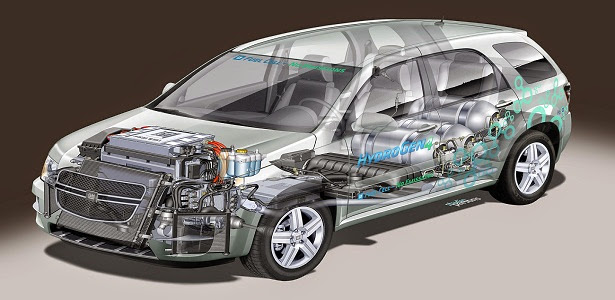
Hydrogen Fuel Cell !!! New source of 'R'energy
This is the world’s first scalable Hydrogen-On-Demand process requiring minimum power input

Download Free Android App For REnergy!!
This is a free android app for this blog : REnergy. I've built this app for the users of my blog to access my posts, works with ease.
Thursday, 16 May 2013
JU prof nominated for Becquerel Prize!!!
Courtesy: Times of India
 A teacher of the electronics engineering department in Jadavpur University — has been nominated for the 2013 Edmond Becquerel Prize.
 Colleagues of Ghosh consider the nomination as a huge achievement in itself, given the rarity of the award been conferred to scientists beyond Europe. Japan’s Masafumi Yamaguchi is the only recipient of the award from Asia.
World Council for Renewable Energy chairman Wolfgang Palz has nominated Ghosh “for his outstanding contributions in developing photovoltaic cells in general and thinfilm photovoltaic cells in particular.”
“It is important considering one cannot self-nominate himself and neither can his institute recommend the name for the award,” said Ghosh, who is currently working in various projects in Kyrgyzstan and Sierra Leone.
“In Kyrgyzstan, I have been working on a project to take solar power to the rural population of that country. In Sierra Leone, we have set up a business incubation centre and the solar power work was done by me. In Gujarat, I am involved in the solar power project of 10 mega watt.
“In addition, the philosophy behind my nomination also mentions that I have taken PV power in 1984 to the deep island village in Bay of Bengal for their participation in education, entrepreneurship development, quality and effective economic activities. Implementation of PV power enhanced the human development index to 16-17% higher than its previous figure. The results have been published in a paper at the Solar World Congress.”
It may be noted that Ghosh has authored 150 scientific and technological publications.
Partha Pratim Biswas, his colleague at the university, said: “He is a valuable asset to the institution and has already received international recognition for his work. Now, his nomination for the award yet again proves the multi-dimensional excellence of JU.”
Biswajit Ghosh was nominated by World Council for Renewable Energy chairman Wolfgang Palz
Wednesday, 15 May 2013
Tuesday, 14 May 2013
Friday, 10 May 2013
Commonly Used Algorithms for MPPT

It is the purpose of the MPPT system to sample the output of the cells and determine a resistance (load) to obtain maximum power f or any given environmental conditions. Essentially, this defines the current that the inverter should draw from the PV in order to get the maximum possible power (since power equals voltage times current).
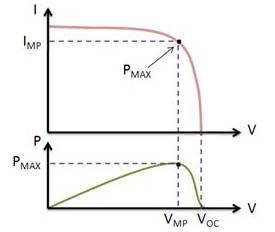 |
| The current and voltage at which a solar module generates the maximum power is known as the maximum power point |
Different Types of MPPT Algorithm
There are various methods or algorithms available to implement Maximum Power Point Tracking. Among them, the most efficient and commonly used methods are-
- Perturb & Observe Method (P&O)
- Incremental Conductance Method (INC)
- Constant Voltage Method
- Current Sweep Method
- Perturb & Observe Method (P&O)
In this method, the device (controller/inverter) adjusts the voltage by a small amount from the array and measures power; if the power increases, further adjustments in that direction are tried until power no longer increases. This method is most common, although this method can result in oscillations of power output. It is referred to as a hill climbing method, because it depends on the rise of the curve of power against voltage below the maximum power point, and the fall above that point. Perturb and observe is the most commonly used MPPT method due to its ease of implementation. This method may result in top-level efficiency, provided that a proper predictive and adaptive hill climbing strategy is adopted.
I've added a flowchart for better understanding of this Method.

- Incremental Conductance Method
In the incremental conductance method, the controller measures incremental changes in array current and voltage to predict the effect of a voltage change. This method requires more computation in the controller, but can track changing conditions more rapidly than the perturb and observe method (P&O). Like the P&O algorithm, it can produce oscillations in power output. This method utilizes the incremental conductance (dI/dV) of the photovoltaic array to compute the sign of the change in power with respect to voltage (dP/dV).
The incremental conductance method computes the maximum power point by comparison of the incremental conductance (ΔI/ΔV) to the array conductance (I/V). When these two are the same (I/V=ΔI/ΔV), the output voltage is the MPP voltage. The controller maintains this voltage until the irradiation changes and the process is repeated.


For Further details on Perturb and Observe Method, please follow this link: Perturb and Observe Method
Follow me on Academia.edu
Maximum Power Point Tracking : Basic Overview
 Solar inverters or charge controllers use maximum power point tracking (MPPT) to get the maximum possible power from the PV array. Solar cells have a complex relationship between solar irradiation, temperature and total resistance that produces a non-linear output efficiency known as the I-V curve. It is the purpose of the MPPT system to sample the output of the cells and determine a resistance (load) to obtain maximum power f or any given environmental conditions.
 Essentially, this defines the current that the inverter should draw from the PV in order to get the maximum possible power (since power equals voltage times current).
Working Principle of Maximum Power Point Tracking:
A Maximum Power Point Tracking solar regulator will simulate the load required by the solar panel to achieve the maximum power from the cell. The regulator will work out at which point the cell will output the maximum power and derive from this the voltage and current outputs required for maximum power to be achieved. It will then calculate the load that it must simulate based on these voltage and current levels R=V/I. The regulator, now receiving the maximum amount of power in, will then regulate the output according to what it is designed for.
In this image you can see that if we use a inverter which works without an MPPT algorithm, then the system become in-efficient or in other words there will be losses in utilizing the solar power. But we use an inverter which works on a MPPT algorithm then the utilizing of power is far better.
Now let's talk about the Fill Factor (FF) which is a very important and of course an integral part of the MPPT methodology.
The fill factor, more commonly known by its abbreviation FF, is a parameter which, in conjunction with the open circuit voltage and short circuit current of the panel, determines the maximum power from a solar cell. A solar micro-inverter in the process of being installed . The ground wire is attached to the lug and the panel's DC connections are attached to the cables on the lower right. The AC parallel trunk open circuit voltage and short circuit current of the panel, determines the maximum power from a solar cell. Fill factor is defined as the ratio of the maximum power from the solar cell to the product of Voc and Isc.

So, the mathematical expression of Fill Factor is FF=(Imp x Vmp) / (Isc x Voc)
Benefits By Using MPPT Based Devices In Solar PV System
MPPT ensures that you get the most power possible from your solar panels at any point in time. It is particularly effective during low light level conditions. These calculations result in an output that delivers maximum current at the required voltage at any point in time. During low light level situations it will compensate for the low light level and find the new point at which the solar cell delivers its maximum power output.
For Details on the Classification of MPPT and the MPPT Algorithm, please see the other posts.
Follow me on Academia.edu
Follow me on Academia.edu
Solar Tracker : Advantage and Disadvantage

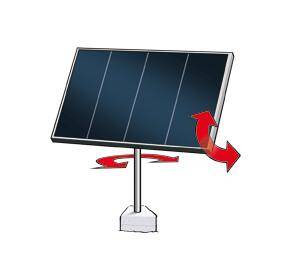
In flat-panel photovoltaic (PV) applications, trackers are used to minimize the angle of incidence between the incoming sunlight and a photovoltaic panel. This increases the amount of energy produced from a fixed amount of installed power generating capacity.
In standard photovoltaic applications, it is estimated that trackers are used in at least 85% of commercial installations greater than 1MW from 2009 to 2012.
Advantages:
The advantages of solar tracker are listed below:
- Solar tracking systems are used to continually orient photovoltaic panels towards the sun and can help maximize the investment in PV system.
- They are beneficial as the sun's position in the sky will change gradually over the course of a day and over the seasons throughout the year.
- Advantages to using a tracker system like this will depend mainly on it's placement in determining how well it will increase the effectiveness of the panels.
- energy production is at an optimum and energy output is increased year round. This is especially significant through out the summer months with its long days of sunlight available to capture and no energy will be lost.
- For those with limited space this means that a smaller array only needs to be installed, a huge advantage for those smaller sites with only a small area to place solar tracker.

Disadvantages
Now let's discuss about the disadvantages of solar tracking system. Today, with boom in solar technology, the use of solar tracker is not necessary as it increases the total set-up cost of the system. The main disadvantages of using solar tracking system are listed below:
- The stand alone PV home kit system is a very reliable and uncomplicated source of energy production; the panels don't move and require little maintenance. By adding a solar tracking system to your solar panels, you are adding moving parts and gears which will require regular maintenance of your solar system and repair or replacement of broken parts.

- The main disadvantage is the investment problem. It has seen that in comparison to the cost and increment in the efficiency, setup and maintenance cost of the tracking system leads. By using the solar tracker the overall efficiency of the system increased by 23-30% whereas the system cost increases by 31-35% (in most of the cases).

- Also the maintenance and repairing of mechanical and electronic parts of the tracking system requires extra man-power and of course extra investment.
Last of all i'd like to conclude that the use of solar tracker in the solar PV installtation is not that much important. We can save this money and put it on utilising the Maximum Power Point Tracking which yields more output from the solar array than the tracker system.

Sunday, 5 May 2013
MPPT based (Perturb & Observe) Solar Charge controller:: Paper Work
ii) Incremental Conductance (INC) Method and iii) Constant Voltage Method. In this paper, the details of Perturb & Observe (P & O) method algorithm and designing and implementing of the algorithm in a charge controller of a Solar PV system (applicable for both grid-tie and stand-alone system) has been presented.
Because of the limited function of this post editor I have to post the the original document of my work here.
Please read the document provided here and give your valuable feedback.
I'm providing the flowchart and block diagram that i've made in the above paper for better and clear view.
Algorithm
Block Diagram
Wind-Solar Hybrid Power Generation Model
 Here i'm going to share my final-year college project "Wind-solar hybrid power generation model" that i've built and completed recently. the very basic outline of this project (or you can say the abstract) is that -The combination of power output from solar PV module and wind mill is being stored and utilized thru' a battery for a stand-alone system. This model also can be used in a grid-tie system with help of a moderate PCU(Power Converting Unit).
Abstract:
Wind power generation and solar power generation are combined to make a WIND-SOLAR HYBRID POWER GENERATION SYSTEM. A 6v, 5Ah lead-acid battery is used to store solar power and charging is controlled by a charger circuit which has been discussed here. Power output of this hybrid system is 7 watts (9VDC, 0.77A DC) .
The Working Model
The working model of Wind-Solar hybrid power generation consists of a twin-turbine wind mill and a solar PV array(with two PV module). First i'm going to discuss about the Wind-mill.
Construction of Wind-Mill
- Here, we used two PMDC (Permanent Magnet DC) motors to work as a generator.
- Both are same rated i.e. 12V, 0.75Amps, 2400 rpm .
- Two symmetrical 3-bladed set made of aluminum used as turbine blade.
- These two-turbine are connected in series so that output voltage is the result of the summation of these twin-turbine set.
- Height of the wind-mill stand is about 24 inches.
- Distance between the turbines is about 8 inches.
- Base of the wind-mill is 6x6 sq. inches
- Diameter of the turbine-holder is 1.25 inches.
- Here, we used two PMDC (Permanent Magnet DC) motors to work as a generator.
- Both are same rated i.e. 12V, 0.75Amps, 2400 rpm .
- Two symmetrical 3-bladed set made of aluminum used as turbine blade.
- These two-turbine are connected in series so that output voltage is the result of the summation of these twin-turbine set.
- Height of the wind-mill stand is about 24 inches.
- Distance between the turbines is about 8 inches.
- Base of the wind-mill is 6x6 sq. inches
- Diameter of the turbine-holder is 1.25 inches.
 |
Twin-turbine Wind-Mill |
 |
Twin-Turbine Wind-Mill at Working condition--powering a 6V LED Circuit |
 |
Voc of each turbine displaying on multimeter |
 |
Voc Testing of the turbine |
 Solar Power Generation

- Here comes the next part : solar power. for solar power generation we used two 6V, 3Watts PV module.
- Connect them in series to get 12V DC output.
- Output of these two module will then feed to a 6V,5Ah lead-acid battery via a charger circuit.
- In this image you can see two solar PV module connected in series whose output are send to the charger circuit and the output of the charger circuit is connected to a 6V, 5Ah lead-acid battery.
- The details of the Charger Circuit provided in another post.Please go through it.Link is here-6V, 5Ah Lead-Acid battery Charger Circuit
 |
Output of the Charger Circuit |
The Whole system:
- Ouput of The lead-acid battery(which is charged by the solar array) is connected in series with the Wid-mill.
- output of this hybrid system is powering up a 6V LED lighting system.
 |
Output of the Lead-Acid Batt. |
 |
Working Charger Circuit |
 |
The Lead-Acid Batt. |
 |
The 6V LED lightng board |
 |
Wind-Solar Hybrid Power Generation Model |
 About the Author
Amrit Mandal is a final year B.tech (EE) Student, Admin of this blog. He likes to work in the renewable energy field-specially in solar energy field.
Follow Us on Twitter #REnergy_Blog
REnergy
Follow Us on Twitter #REnergy_Blog
Saturday, 4 May 2013
Design Estimation of 5KWp Solar BIPV power system (Grid-tie)
 this post is about a paper i made on designing and estimating the components and the various parameters required to set-up a 5KWp Building Integrated Photo-Voltaic Solar power system(grid-tie). I took our college buliding as a location because of simplification of the calculation. I included the detailed report on this paper here.kindly read it and post your feedback.
thank you
Follow me on Academia.edu
About the AuthorAmrit Mandal is a final year B.tech (EE) Student, Admin of this blog. He likes to work in the renewable energy field-specially in solar energy field.
Follow Us on Twitter #REnergy_Blog
REnergy
Follow Us on Twitter #REnergy_Blog
Subscribe to:
Posts (Atom)


